Jaipur tourist places: a plan by area and by day

Jaipur tourist places at a glance
In short: The Jaipur tourist places worth your time are the City Palace, Hawa Mahal, Jantar Mantar and the three hill forts. Group them by area: the old city on one day, the forts on another.
Most lists for this search give you thirty names and no order. You then spend the trip crossing the city twice. If you are coming from Delhi as a group and want one fixed price for a vehicle with a driver, you can send the route, date and number of people on WhatsApp from the home page and a trip manager replies.
We rent vehicles with a driver from New Delhi, and Jaipur is one of the routes on our site. Our list puts it 280 km from Delhi. So we think about how a day moves through this city more than we think about which palace is prettiest. This post is that thinking. It gives you a core list, an order, the hours we could read on official pages, and a plan for one, two or three days. Where we could not confirm something, we leave it out.
How we chose these places
Open the pages that rank for this search and the same names keep coming back. Amer Fort, City Palace, Hawa Mahal, Jantar Mantar, Jaigarh, Nahargarh and Jal Mahal turn up on almost all of them. We agree with that core. It is ours too.
We did two things differently. We wrote down an opening time only where we could read it on the Incredible India pages, and we say that is where it came from. And we grouped places by where they sit, because in Jaipur the gap between two sights decides your day more than the sights do.
One caution before the list. Opening hours change. Some of those pages do not say whether the hours apply every day, and none of them gave a weekly closing day. So treat every time here as something to check the day before. We don't promise entry anywhere, and we don't promise weather, road conditions or arrival times.
A word on the long list. Incredible India lists 30 attractions in Jaipur. Nobody sees thirty. The ones below are the ones that reward the time.
The hours, side by side
Opening hours the official pages give, earliest opening first
| Place | Opens | Closes |
|---|---|---|
| Jal Mahal (viewing) | 6:00 AM | 6:00 PM |
| Hawa Mahal | 09:00 AM | 04:30 PM |
| Jantar Mantar | 09:00 AM | 05:00 PM |
| City Palace | 9:30 AM | 7:30 PM |
| Jaigarh Fort | 09:30 AM | 05:00 PM |
| Nahargarh Fort | 10:00 AM | 05:30 PM |
Source: Incredible India, and the pages for each place named below
Amer Fort is not in the table. Its hours are in our Amer Fort post, read from the same portal. Now look at the Closes column. The Hawa Mahal shuts at 04:30 PM, earlier than every other place on this list. So it goes first in the day, not last. The City Palace is the other end: it stays open until 7:30 PM, which makes it the one you can leave for the end of a full day.
The Albert Hall Museum has two sessions, 09.00 AM to 05:00 PM and then 07:00 PM to 09.30 PM, and we come to it below.
The old city: Hawa Mahal, Jantar Mantar and City Palace
If you have one day, spend it here. These three sit close together. The Hawa Mahal page names Jantar Mantar, City Palace and Albert Hall as nearby attractions, and a walled city is a good thing to walk.
A little history makes the streets make sense. Wikipedia says Jaipur was founded on 18 November 1727 by Sawai Jai Singh II, and that the planner, Vidyadhar Bhattacharya, divided it into nine blocks, with seven fortified gates in the ramparts. It is a planned city with a grid, which is why it is easy to walk. The same page says it was painted pink in 1876 to welcome Albert Edward, Prince of Wales, and many avenues are still that colour. It also says the historic city centre went onto the World Heritage List on 6 July 2019. (UNESCO's own page returned an error when we tried to read it, so we lean on Wikipedia for that date and say so.)
Hawa Mahal
The palace of winds. It is the face on every postcard, and it is built from local pink sandstone. Incredible India gives 1799 and Maharaja Sawai Pratap Singh as the builder, and counts 953 windows, which it calls jharokhas, the overhanging balconies. It rises five storeys. The page also describes a latticed screen, the Aakash Patal Jali, that let women watch the street without being seen.
Here is the detail most visitors miss. The page says there is no front entrance, only a rear one, and that ramps and not stairs lead to the upper floors. So the grand street face you photograph is not the way in. You walk round. Inside is a small museum of Rajasthani miniature art.
Our advice: photograph it from the street, then go in. Opening is 09:00 AM, closing 04:30 PM. Go early.

Jantar Mantar
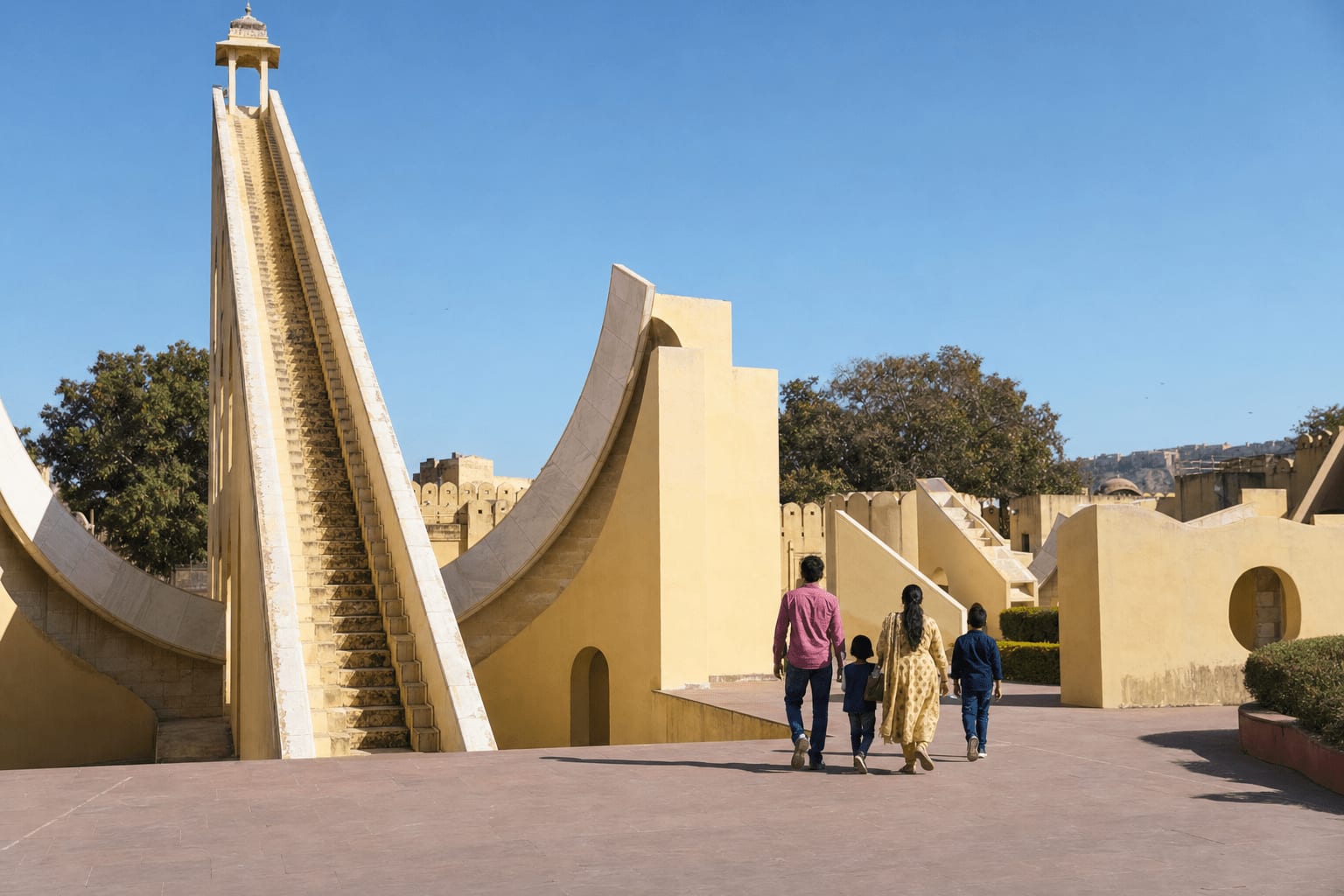
An observatory, built by the king who founded the city. Incredible India says it was built between 1728 and 1734, and that of the five observatories Jai Singh II established it is the largest. It is a UNESCO World Heritage Site. Wikipedia puts the designation at 2010 and counts 19 instruments.
What you see are large stone structures that read the sky with the naked eye. The Vrihat Samrat Yantra, the big sundial, is 88 feet (27 m) high, according to the same Wikipedia page, and it has an observation deck. At the Jai Prakash Yantra the observer can move inside the instrument. Children tend to like a place where you can walk into the machine.
It is open 09:00 AM to 05:00 PM. A guide is worth having here more than almost anywhere in Jaipur, because the instruments mean little without someone to explain what each one measures. A guide can be added separately with us. The driver is a driver, not a licensed tour guide.
City Palace
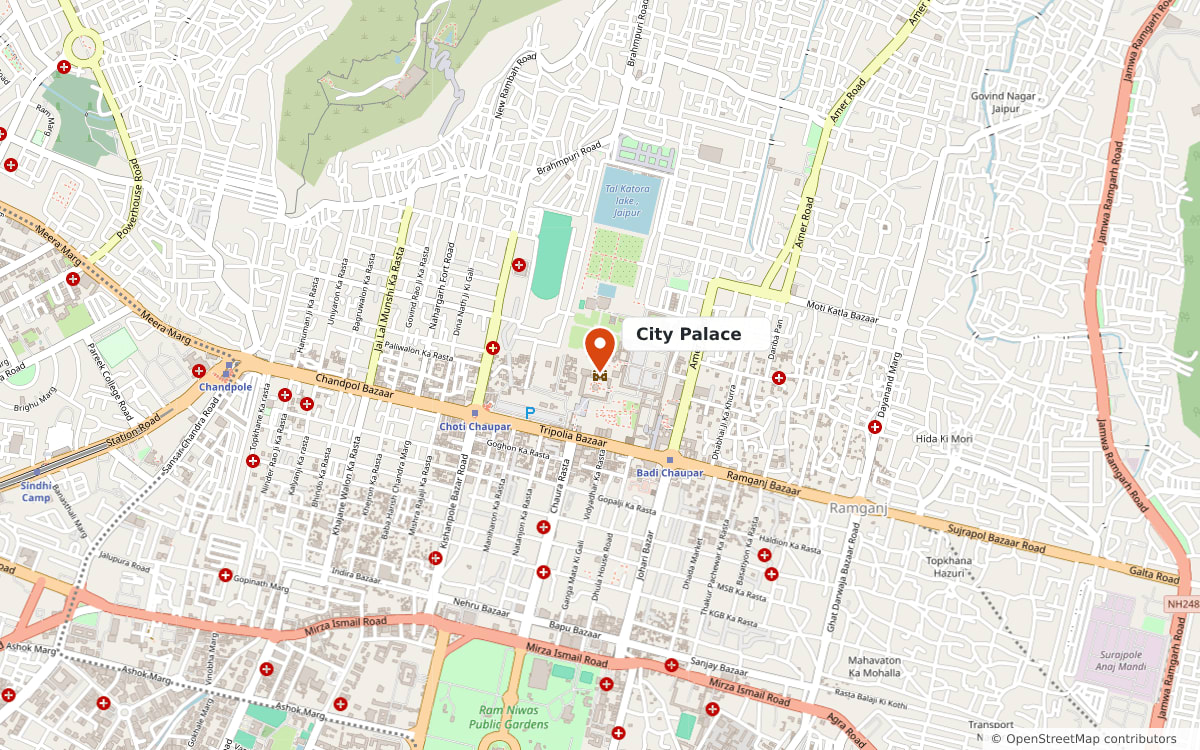
Incredible India says Sawai Jai Singh II founded the City Palace in 1727 and oversaw its construction between 1729 and 1732. The style blends Rajasthani and Mughal. Hours are 9:30 AM to 7:30 PM, though the page does not say whether they apply every day.
Plan for how it is laid out. You go in through the Virendra Pol, and beyond it is the Mubarak Mahal, a cream-coloured haveli that now holds part of the Maharaja Sawai Man Singh II Museum. A marble gateway, the Rajendra Pol, leads to the central courtyard, the Diwan-E-Khas. And the Chandra Mahal is a seven-level tower. The page says part of the complex is still the residence of the present royal family.
Tickets matter here. The page says a standard ticket covers the first floor, and that a separate "Royal Splendour" ticket covers the other exclusive areas. We quote no rupee amounts, because we did not find an official price page. Decide at the counter which one you want, and don't pay anyone outside the gate.
The page gives Jaipur Junction as about four kilometres away. That is a useful number if some of your group came by train and are meeting you.
Albert Hall Museum, in the evening
Here is the one that suits the end of the day. Incredible India gives its hours as 09.00 AM to 05:00 PM and again from 07:00 PM to 09.30 PM. It says the museum was commissioned in 1868 and opened to the public in 1887, and holds 16 galleries and about 20,000 artefacts. It also says the building is lit every night.
So an evening session exists. If your group is tired by four, rest, eat, and come back. We could not read an official page for the evening ticket, so we say nothing about it. Ask when you get there.
The hills: Amer, Jaigarh and Nahargarh
Three forts stand on the ridges around the city, and they are the other half of the trip. They are not close to the old city. Do them as a separate morning and afternoon, not as add-ons.
Amer Fort
The best known, and the one we have written most about. It sits outside the city, on its own hill. Our Amer Fort post has the distance from the centre, the hours, the courtyards in order, the elephant question, and a plan for doing the fort as a day trip from Delhi. We won't repeat it. If the fort is the one thing you came for, read that first.
Jaigarh Fort
Incredible India says Jai Singh II commissioned Jaigarh in 1726, and that it stands about 15 km from Jaipur. The name means Fort of Victory. The same page says its sandstone walls run over 3 km, and that it was built as a frontier defence for Amer, "in its shadow", so its walls can be seen from anywhere inside Amer Fort.
It also says the fort was the dynasty's main cannon foundry, and that the Jaivana cannon "remains the largest cannon on wheels to this day". Hours are 09:30 AM to 05:00 PM. Pair it with Amer on the same morning. It is the logical second stop, and you are already on that side of the city.
Nahargarh Fort
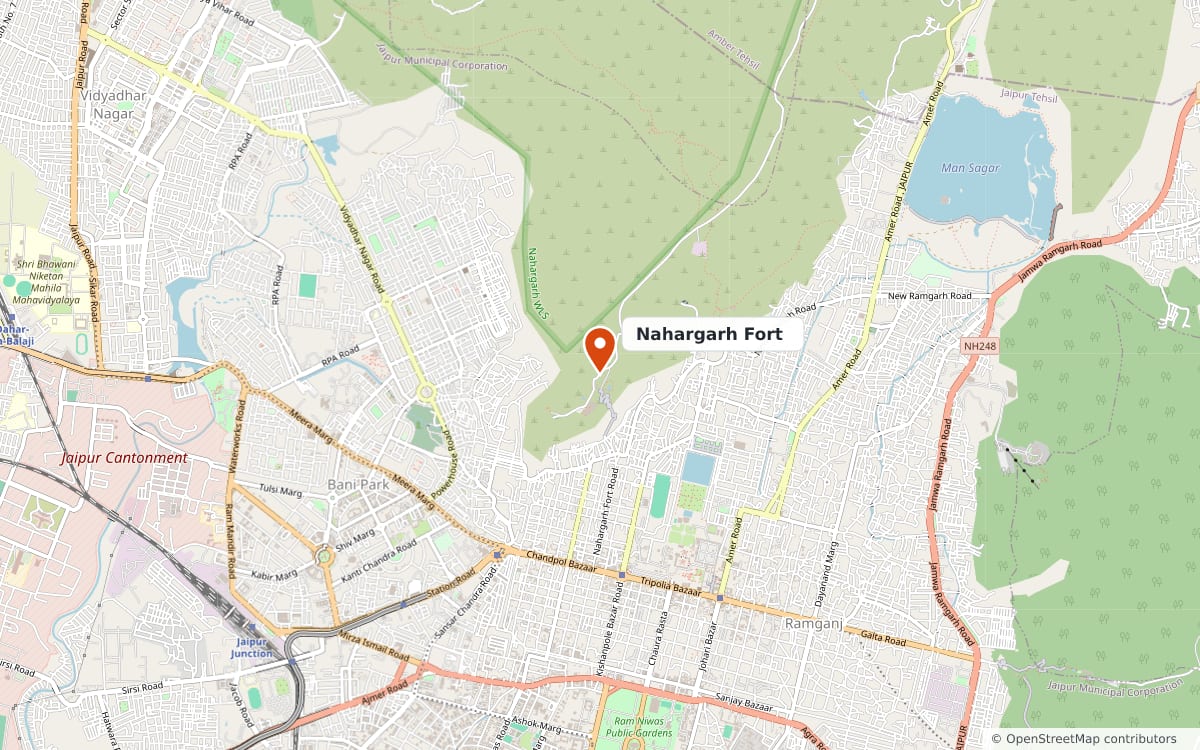
Nahargarh is the one for the view. The page says it was completed in 1734, first named Sudarshangarh, and that the ramparts give panoramic views of the city. It lists the Tadigate entrance, the open-air Diwan-I-Aam, and the Madhavendra Bhawan, a two-storey building with nine apartments. It also mentions a sculpture park and a wax museum.
Hours are 10:00 AM to 05:30 PM, and that makes it the one to do in the afternoon of a fort day, after Amer and Jaigarh. We did not read a source about sunset at Nahargarh, so we won't tell you it is the sunset spot. With a 05:30 PM close, check before you plan a late arrival around the light.

Jal Mahal and the places in between
Jal Mahal sits in Man Sagar Lake. The official page says it is a red sandstone palace, that most of the building is submerged, and that it opens 6:00 AM to 6:00 PM. It says foundations were laid in 1699 and that Jai Singh II renovated the palace and the lake in the 18th century.
What the page describes is viewing from the shore, a boat trip, and birdwatching. It does not say visitors can go inside, so we won't either. Treat it as a short stop for photographs, not a destination. Its hours are the widest of any place in the table, so it can go at the very start of a day, before anything else has opened.
Other Jaipur tourist places, if you have the days
Wikipedia's list of tourist attractions in Jaipur groups the rest. Among the temples it names Govind Dev Ji, Birla Mandir, Garh Ganesh and Galtaji. Among the gardens, Ram Niwas Garden and Sisodia Rani Garden and Palace. It also lists Rambagh Palace, Diggi Palace, Jaipur Zoo and the Raj Mandir Cinema, and festivals such as Gangaur and Teej.
We have not read official pages for the hours of these, so we are not describing them. Look each one up, and check its hours as you would for the others. Two honest notes. First, a temple is a place of worship, and what is expected of visitors differs from place to place. Ask at the gate. Second, none of these should replace the City Palace or Amer if it is your first visit. They are what you add on a third day.
One, two or three days
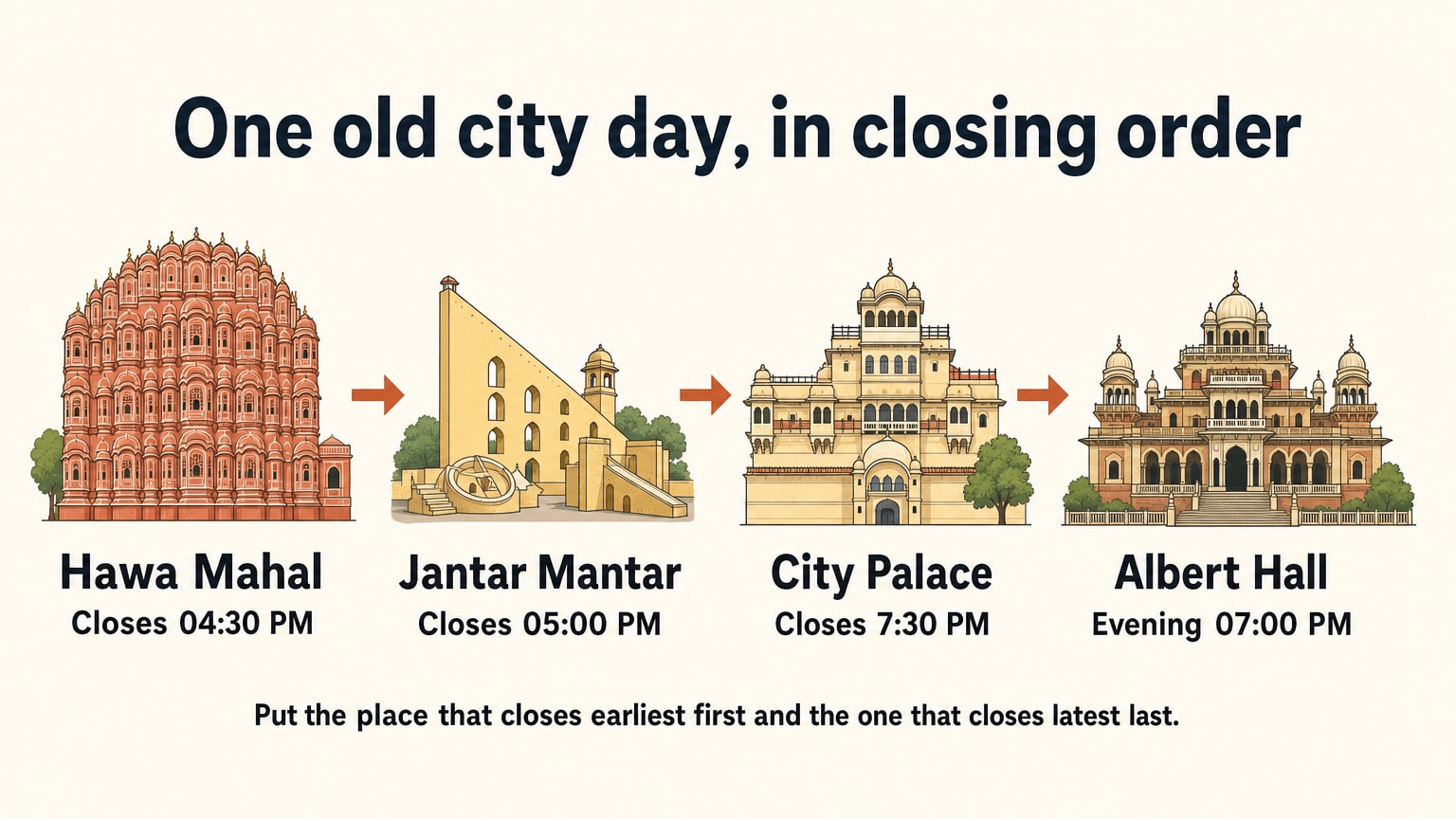
Here is the part the lists leave out. Same places, three lengths of trip. Order is the whole trick: put the place that closes earliest first, and the place that closes latest last.
Three ways to spend your days in Jaipur
| Length | Day 1 | Day 2 | Day 3 |
|---|---|---|---|
| One day | Hawa Mahal, Jantar Mantar, City Palace | ||
| Two days | Hawa Mahal, Jantar Mantar, City Palace, Albert Hall in the evening | Amer, Jaigarh, Nahargarh | |
| Three days | Same old city day | Same fort day | Jal Mahal, then something from the other list |
If you only have one day, be honest about it. The old city can be done properly in a day. The forts can't be added to it without everybody being tired by noon. A reader who wants forts more than palaces should swap the days and do Amer, Jaigarh and Nahargarh, leaving the city for a longer visit.
If you have one day
Start with the Hawa Mahal at 09:00 AM, because it is the first to close, at 04:30 PM. Then Jantar Mantar, which opens at 09:00 AM and closes at 05:00 PM. Then the City Palace, which opens at 9:30 AM and stays open to 7:30 PM. If the group still has energy at the end, that late close is your margin.
Keep it to those three. A family of ten with two older relatives spends longer at each place than a couple does. Let them set the pace. Cut a stop without a debate.
If you have two days
This is the best fit for most families. One day for the city, one for the hills. Each day has a natural end: the Albert Hall lit up in the evening on the first, and the view from the Nahargarh ramparts on the second. Neither day is so full that older relatives are finished by lunch.
On the fort day, go to Amer at opening, then Jaigarh, which opens at 09:30 AM, then Nahargarh, which opens at 10:00 AM. The 05:30 PM close at Nahargarh is the one to watch.
If you have three days
Give the third day to whatever the group cared most about. More temples, a garden, the lake. Or nothing. A day with a single thing in it is a gift when the other two were busy.
Coming from Delhi for the day
It can be done, but it is a long day on the road, and one place is about all it holds. Our Amer Fort post works through the same road hour by hour. If you can spare the night, take it, because two real days in Jaipur are a different trip from one hard day in a vehicle. We don't book hotels, but we can plan the route around the night you choose. And if you are weighing a package against the road alone, our Rajasthan tour package post shows how to read one.
When to go
Heat decides this. Incredible India gives no recommended months for Jaipur, only monthly temperature ranges. So the reading below is ours, not theirs.
Jaipur's monthly temperature range in °C, low to high
| Month | Range |
|---|---|
| January | 3.5 - 27.6 |
| March | 11.6 - 37.6 |
| May | 21.5 - 44.8 |
| July | 22.9 - 39.9 |
| October | 15.4 - 37.1 |
| November | 9.8 - 33.4 |
| December | 5.4 - 29.0 |
Source: Incredible India, Jaipur
Read the second number. January tops out at 27.6 and May at 44.8. A fort on a ridge has little shade and a lot of stone, so the cooler months are the easy ones. We use October to March as a rule of thumb, which is also what our site says for Agra, and the table fits it. Cooler does not mean cold at night. The January low is 3.5, so bring a layer.

If your dates are fixed and fall in the hot months, the plan changes. It does not break. Be at each place when it opens. Rest in the middle of the day. Carry water in the vehicle. Take the forts in the morning, and keep the old city, with the City Palace's later close, for the afternoon.
We read no visitor-count source, so we won't say which month is busiest. The cooler months are the ones most people choose, so expect more people at the popular places then.
Getting around Jaipur as a group
A couple can get around Jaipur with whatever is passing. A group of 12 or 20 needs a plan, because the old city is a walled grid and the forts have approach roads and car parks built for ordinary traffic.
Choose the vehicle by the number of travellers, then by luggage.
Vehicle by group size, from our home page
| Travellers | Vehicle | Seats |
|---|---|---|
| 1 to 6 | Innova Crysta or Hycross | Car |
| 7 to 12 | Tempo Traveller | 12 |
| 13 to 16 | Force Urbania | 16 |
| 17 to 20 | Tempo Traveller | 20 |
| 21 to 27 | Mini bus | 27 |
| 28 to 41 | Luxury coach | 41 |
If your group is exactly 12, a 12 seater is full, and a day with bags and water bottles will feel it. Ask about the next size up. We would rather you ask than find out at the door. For ten people, our post on the 10 seater car in India explains why 12 seats is the better fit.
Our price is one figure that includes tolls, state tax, parking and driver allowance, so you pay the driver nothing on the road. That parking line matters on a day that stops at five places. Our guide to car rental in Delhi explains what an all-in price should cover, and what to ask any operator.
The fleet is our own, and the vehicle you see is the one that arrives. You get the driver's name, phone number and vehicle number 24 hours before pickup. Our drivers speak English and are KYC-checked, so guests from abroad feel at ease. We hold All-India permits. We take enquiries on WhatsApp and phone. We have not published cancellation terms, so ask the trip manager and get the answer in writing.
Agree two things at every stop
Where will the vehicle wait, and what time do we meet it? The Hawa Mahal has a rear entrance only, so a group that goes in at the back and comes out at the back should know which street the driver will be on. Big sites can have more than one gate. Settle it before anyone gets out, and save the driver's number.
Habits that save the day
Start with the place that closes earliest. Check the day the evening before, because we found no closing days on any of these pages and one will surprise somebody. Wear shoes with grip: the forts are old stone on a hill, and the Hawa Mahal's upper floors are reached by ramps. Plan three places a day and let a fourth be a gift.
And ask yourself at lunch whether the afternoon is really for everyone. People remember a good day, not a full one.
If you are planning the Delhi end as well, our guide to the best places to visit in Delhi groups those sights by area too, and more guides will follow on the blog.
Frequently asked questions
What are the best Jaipur tourist places?
Amer Fort, the City Palace, Hawa Mahal, Jantar Mantar, Jaigarh Fort, Nahargarh Fort and Jal Mahal. They appear on almost every ranking page for this search. Group them by area: Hawa Mahal, Jantar Mantar and City Palace together, and the three forts on another day.
How many days do you need in Jaipur?
One day covers the old city: Hawa Mahal, Jantar Mantar and the City Palace. Two days adds Amer, Jaigarh and Nahargarh. A third day is for the temples, gardens or lake, or for a day with nothing in it.
What is the best time to visit Jaipur?
Incredible India gives no recommended months, but its table shows a January high of 27.6 °C and a May high of 44.8 °C. We use October to March as a rule of thumb. In the hot months, be at each place when it opens.
What are the Hawa Mahal timings?
Incredible India gives 09:00 AM to 04:30 PM. It is the earliest closing of the main Jaipur sights, so visit it first in the day. Confirm the day before.
Can you enter Jal Mahal?
The official page describes viewing the palace from the lake shore and taking a boat trip, and it does not say visitors can go inside. It gives hours of 6:00 AM to 6:00 PM.
Is Jaipur worth a day trip from Delhi?
For one place, yes, if you leave very early. Our route list puts Jaipur 280 km from Delhi. It is a long day, and we can't promise arrival times. Two days gives you the old city and the forts without a rush.
Can you add a guide or tickets to a Jaipur trip?
Yes. A guide can be added separately, and we help with tickets. The driver is not a licensed tour guide. A guide is most useful at Jantar Mantar and the forts.