Best places to visit in Delhi, grouped by day

The best places to visit in Delhi, in one answer
In short: The best places to visit in Delhi are the Red Fort, Jama Masjid, India Gate, Humayun's Tomb, Qutub Minar, the Lotus Temple and Akshardham. Group them by area, and check Monday first: two of them close.
Most lists give you twenty-seven names and no order. That is how a group ends up in Old Delhi at ten, the far south at noon, and back in Old Delhi at four, with half the day spent in the vehicle. If you are going as a group and want one fixed price for a vehicle with a driver, you can send the route, date and number of people on WhatsApp from the home page and a trip manager replies.
We rent vehicles with a driver from New Delhi, so we think a lot about how a day moves across this city. This post is that thinking, written for you. It is not a ranking. It is a way of choosing what to see, then putting it in an order that doesn't waste the day.
How we chose these places
The ranking pages for this search agree on a core. The Red Fort, India Gate, Qutub Minar, Humayun's Tomb, the Lotus Temple, Jama Masjid, Chandni Chowk and Akshardham turn up on most of them. We agree with that core, so it is our core too.
We did two things differently. First, we only wrote down a timing or a closing day if we could read it on an official page, and we say which one. Second, we grouped places by the part of the city they sit in, because in Delhi the distance between two sights decides your day more than the sights do.
One caution before the list. Opening rules in Delhi change. The Red Fort is a recent example, and it is in the table below. Treat every timing in this post as something to confirm when you plan, not as a promise. We can't promise entry anywhere, and we don't promise weather, road conditions or arrival times either.
Check the closing day first
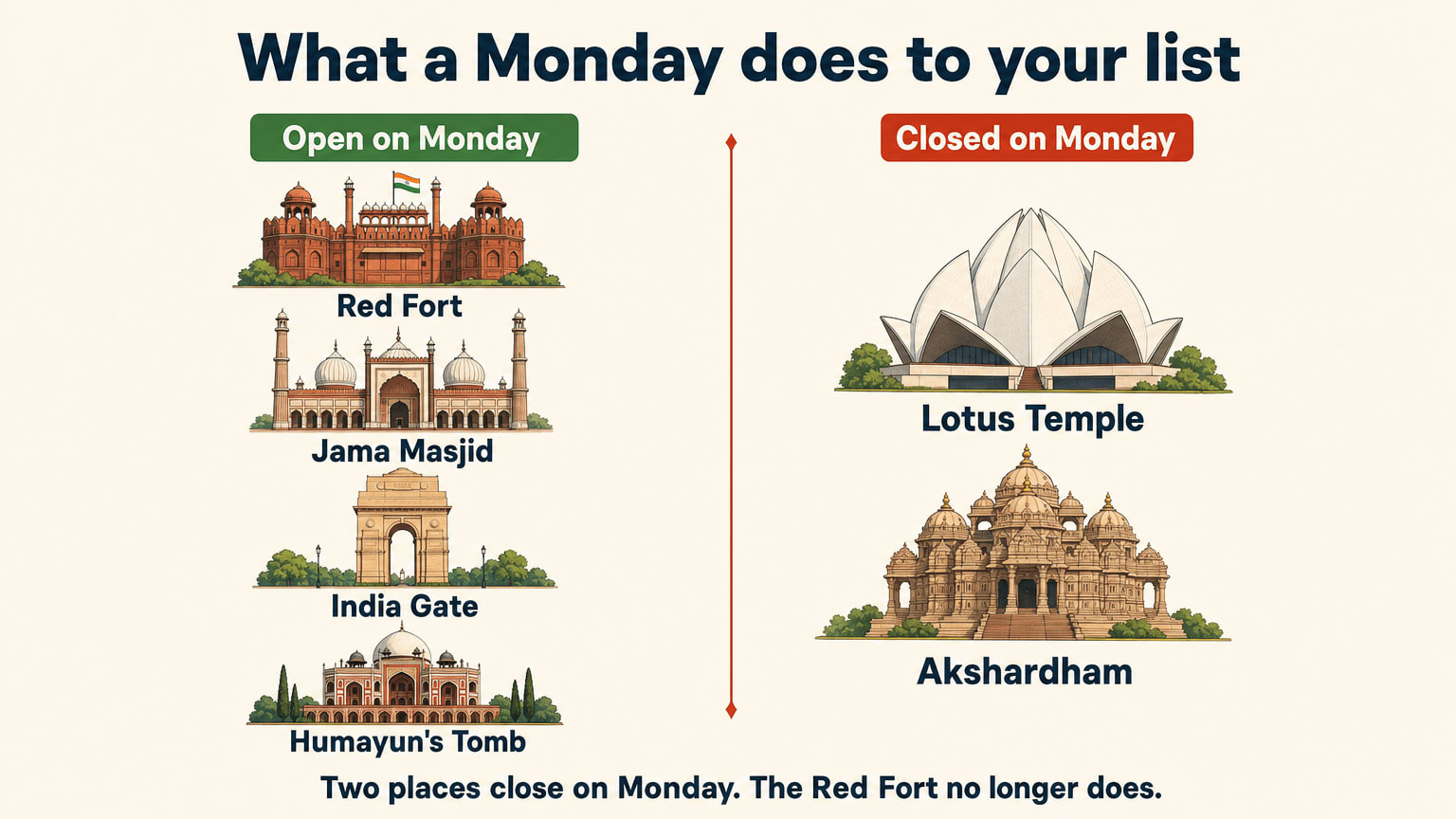
Monday catches more visitors out than anything else in Delhi. Two places on this list are closed on a Monday, and a third used to be.
Days and hours for the main sights, from official pages
| Place | Closed | Hours given |
|---|---|---|
| Red Fort | No weekly closure since February 2026 | Sunrise to 9:00 pm |
| Jama Masjid | Open every day | Tourist hours until sunset |
| India Gate | Not closed | Morning to night |
| Humayun's Tomb | Open daily | Sunrise to sunset |
| Qutub Minar | No day listed | Sunrise to 08:00pm |
| Lotus Temple | Monday | 9am to 5:30pm |
| Akshardham | Every Monday | First entry 10:00 am, last entry 6:30 pm |
Source: Delhi Tourism, Akshardham, Business Today
Read the Red Fort row twice. For years the fort was closed on Mondays, and a great many websites still say so. The Archaeological Survey of India ordered otherwise: the Red Fort will now remain open to visitors on all days of the week, including Mondays, in an order dated 13 February 2026. So a page that tells you to avoid Monday for the fort is out of date. We still suggest you check the day before, because one order in February is not a promise about every holiday.
The Lotus Temple and Akshardham are different. Delhi Tourism lists the Lotus Temple as open Tuesday to Sunday, 9am to 5:30pm, with Monday closed, and entry is free. Akshardham's own visitor page says "Closed: Every Monday". If your free day is a Monday, those two are the ones to drop.
The Qutub Minar row says "no day listed" because the Delhi Tourism page gives hours but no days. We would rather say that plainly than guess.
Old Delhi: Red Fort, Jama Masjid and Chandni Chowk
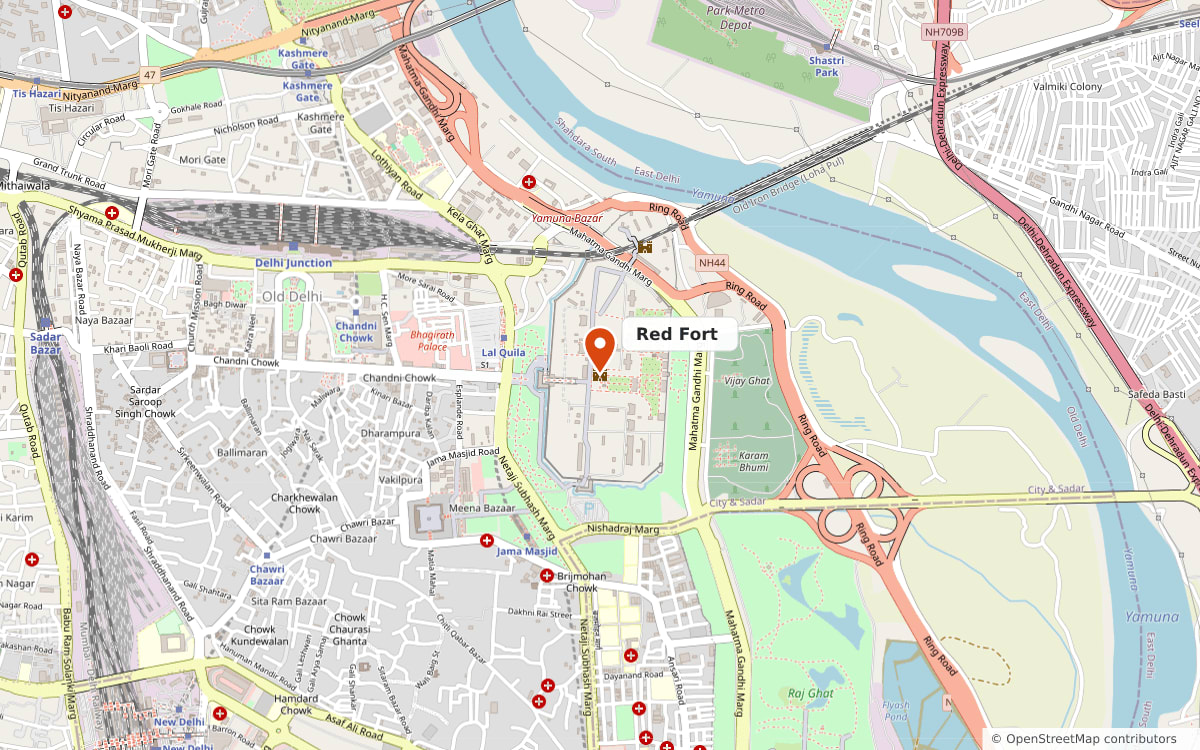
If you only have a morning, spend it here. Old Delhi is where the Mughal city was built, and its big buildings sit close together.
Red Fort
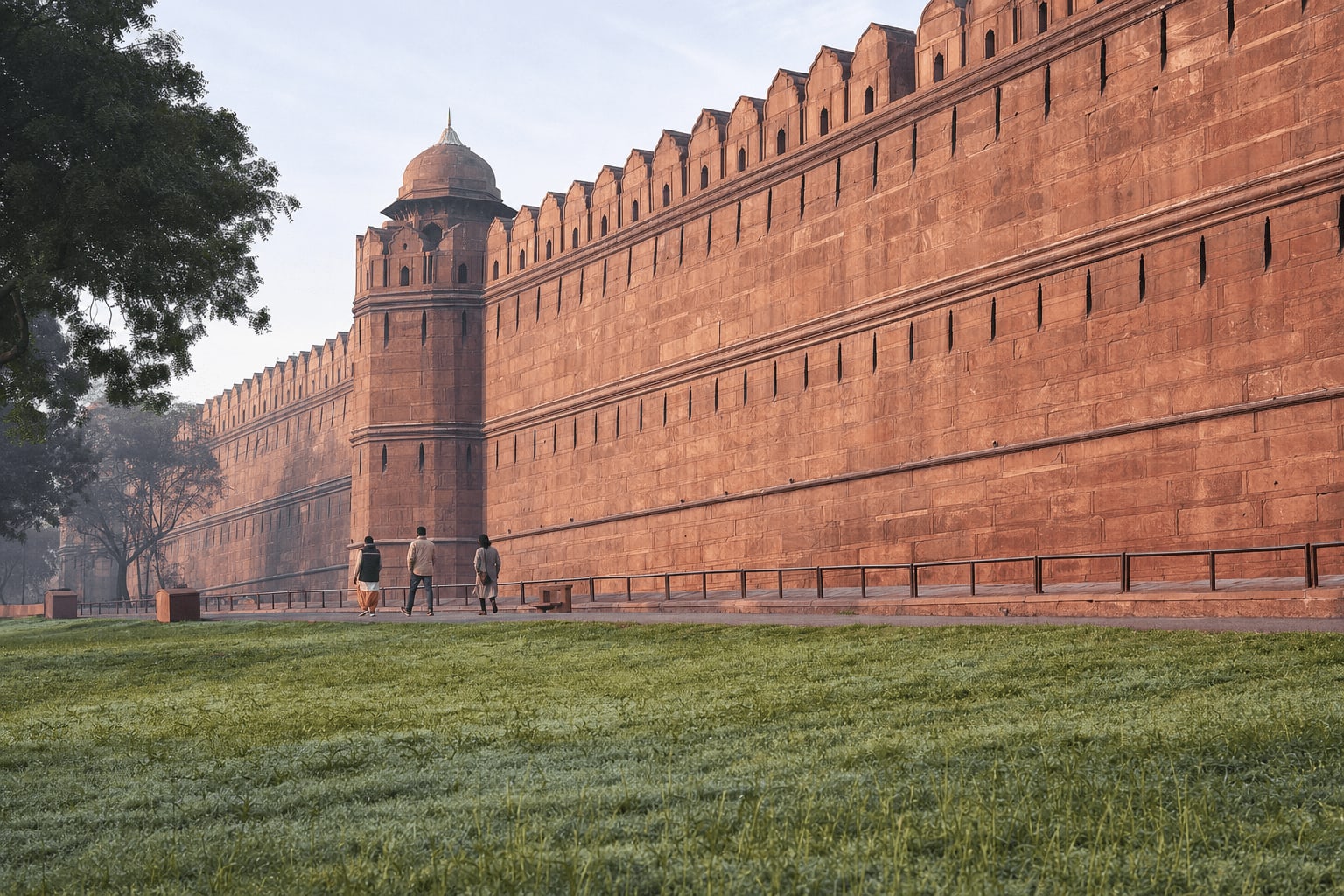
Shah Jahan built it. Delhi Tourism gives 1638 for the fort and describes walls that rise 33 metres above the noise of Old Delhi. It is one of Delhi's three World Heritage monuments on that page, and it is the one most people see first.
Give it a good part of the morning. It is a large complex, not a single building, and the walk between its parts is longer than it looks from the gate. Wear shoes you can walk in. If you are travelling with older relatives, think about how far each of them can walk before you plan the rest of the day around it.
Business Today gives the hours as sunrise to 9:00 pm under the new order. Hours at monuments move with the season and with notices, so confirm them when you plan.
Jama Masjid
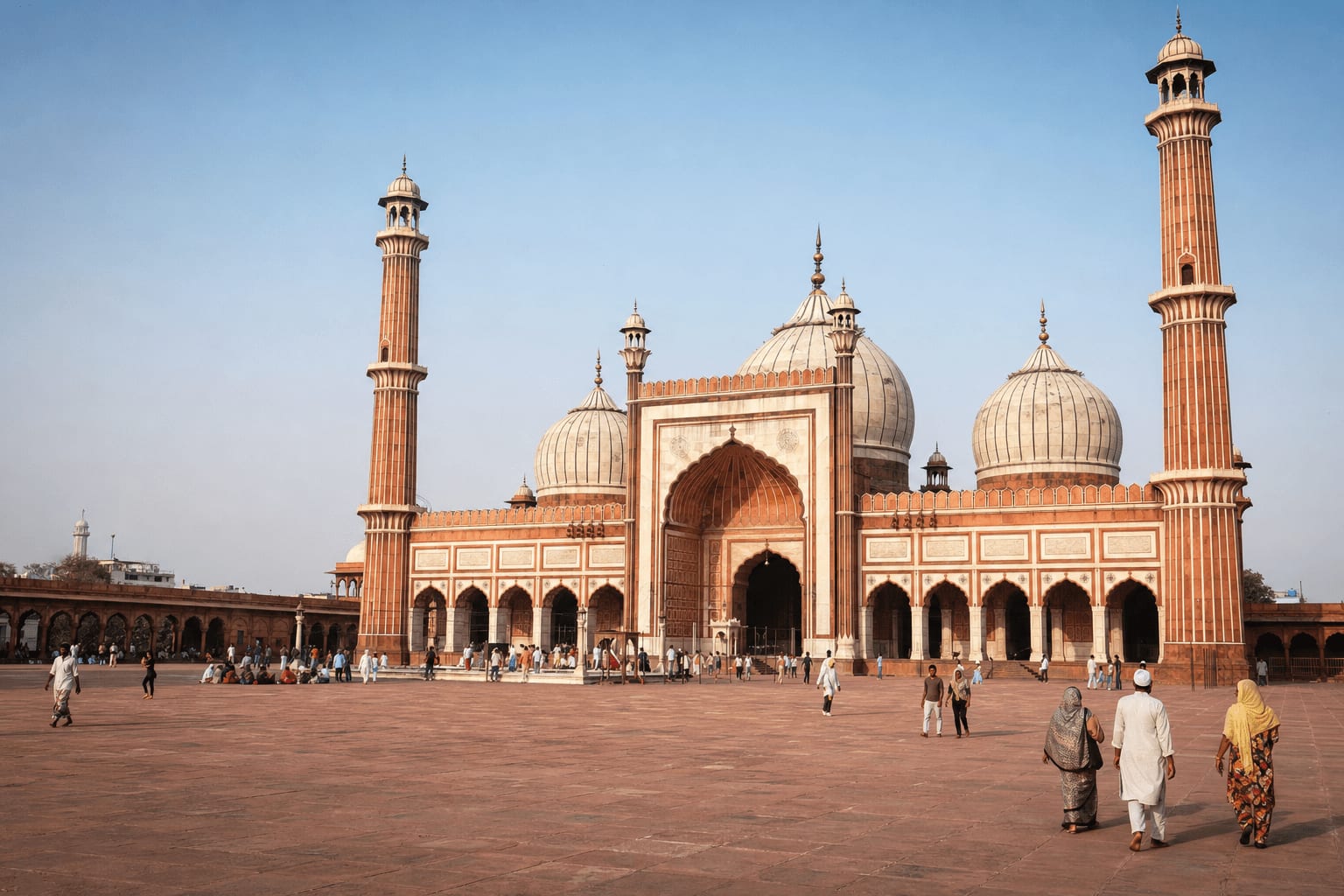
Delhi Tourism says work on Jama Masjid began in 1644 and that it was the last architectural extravagance of Shah Jahan. It is a working mosque, which matters more for your plan than its history does.
The same page gives tourist hours of 8:00 AM until sunset for foreign tourists and 11:00 AM until sunset for Indian tourists. It also says that after sunset only devotees are allowed in for the evening prayer, and that the mosque then closes until tourist hours begin again. So the practical rule is simple. Go in daylight.
If your group includes people who want to go inside, ask at the gate what is expected of visitors. We did not find a dress rule on the official page, so we won't state one as fact. Jama Masjid is also the one place on a mixed day that you can't do late. Put it before the evening, not after.
Chandni Chowk
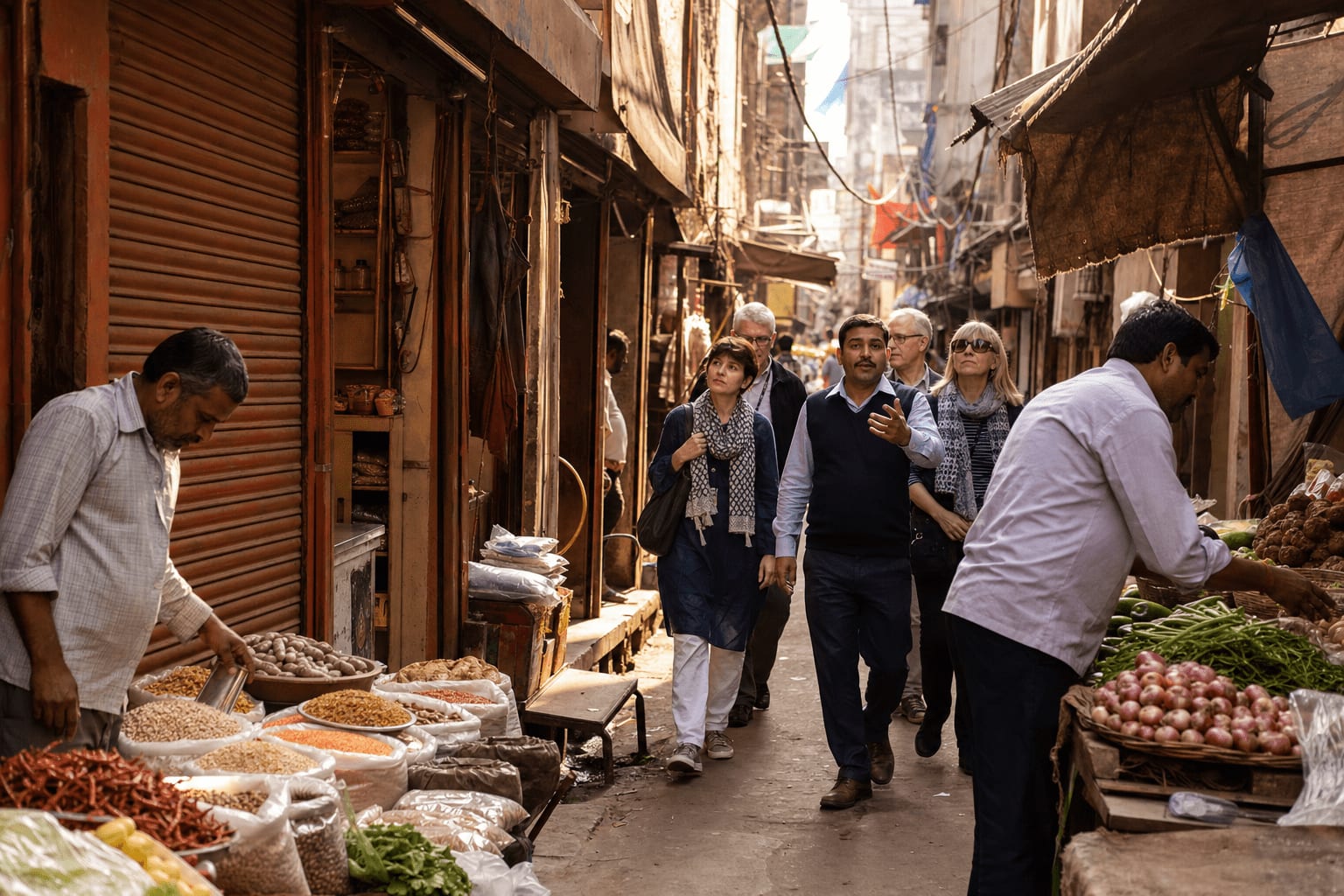
Chandni Chowk is the market that the ranking pages put in their top ten, usually as the place for food and shopping in Old Delhi. We haven't found an official page with timings, so we won't quote any. What we can say from how trips go is this: it is a place to arrive with a small group and a lot of patience.
A large vehicle is not the way into a crowded market. If you are 12 or 20 people, the sensible plan is to be dropped at the nearest point the driver can reach, agree a pick-up time and a pick-up place, and walk the rest. Save the driver's number before you get out. We send the driver's name, phone number and vehicle number 24 hours before pickup, so that you are not hunting for a vehicle in a lane full of people.
Eat when you are hungry, not when the group decides to. It is the one piece of advice we would give anyone who has been to this street.
Central Delhi: India Gate and the wide roads
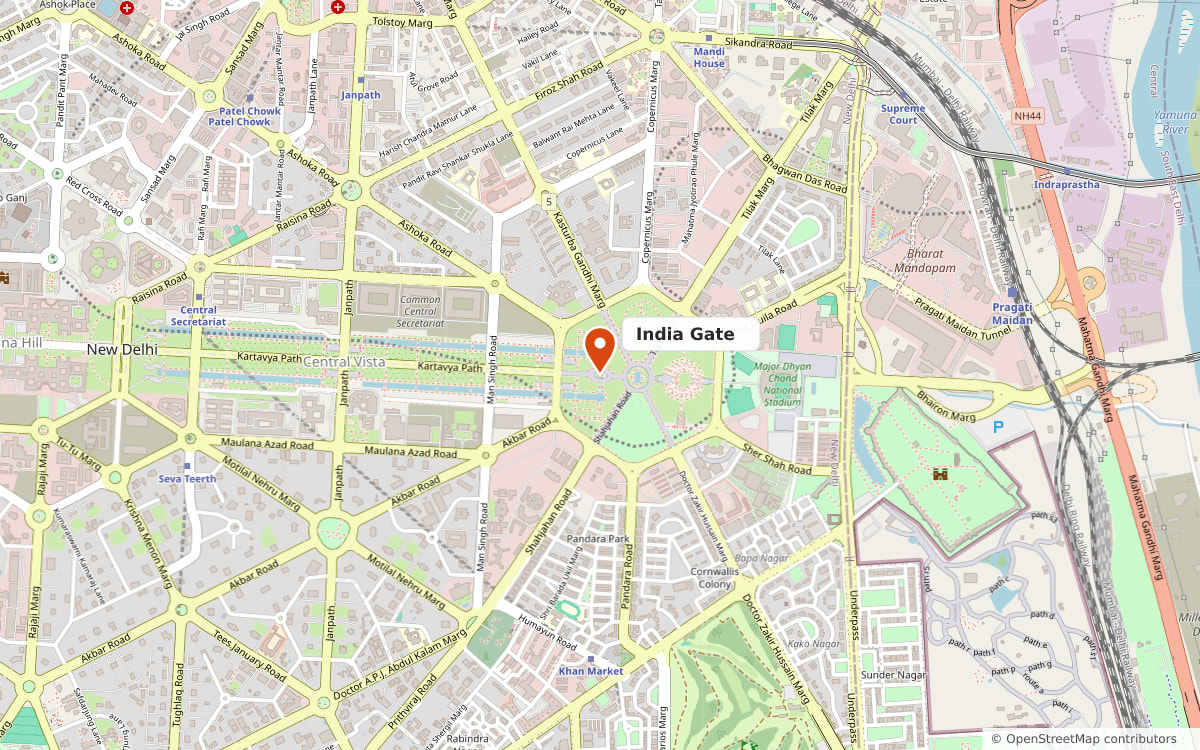
The mood changes a few kilometres on. Old Delhi is close and loud. The central part of the city is wide and green by comparison, and it suits a slow walk at the end of the day.
India Gate
India Gate is a 42-metre archway designed by Edwin Lutyens, with its foundation stone laid in 1921. Delhi Tourism says it commemorates 70,000 Indian soldiers who lost their lives fighting for the British Army in the First World War. Entry is free, and the page lists the hours as morning to night.
That last point is why it works so well as the end of a day. Everything else on this list has a closing time. India Gate doesn't, so it can take the slot that is left when the rest of the plan has run long. It is also an easy place for a group to find each other again: one arch, plenty of open space, and a free entry.

Shri Bangla Sahib Gurudwara sits in the same part of the city, and the ranking pages put it in this group too. It is a working place of worship, and we haven't read an official page for its rules, so we won't quote any. If it is on your list, ask the driver to fit it in on the way and allow for a stop that is about prayer, not photographs.
South and east: Humayun's Tomb, Qutub Minar, Lotus Temple and Akshardham
These are the places where the vehicle matters most. They are further apart than the ones above, and each is a full stop of its own.
Humayun's Tomb
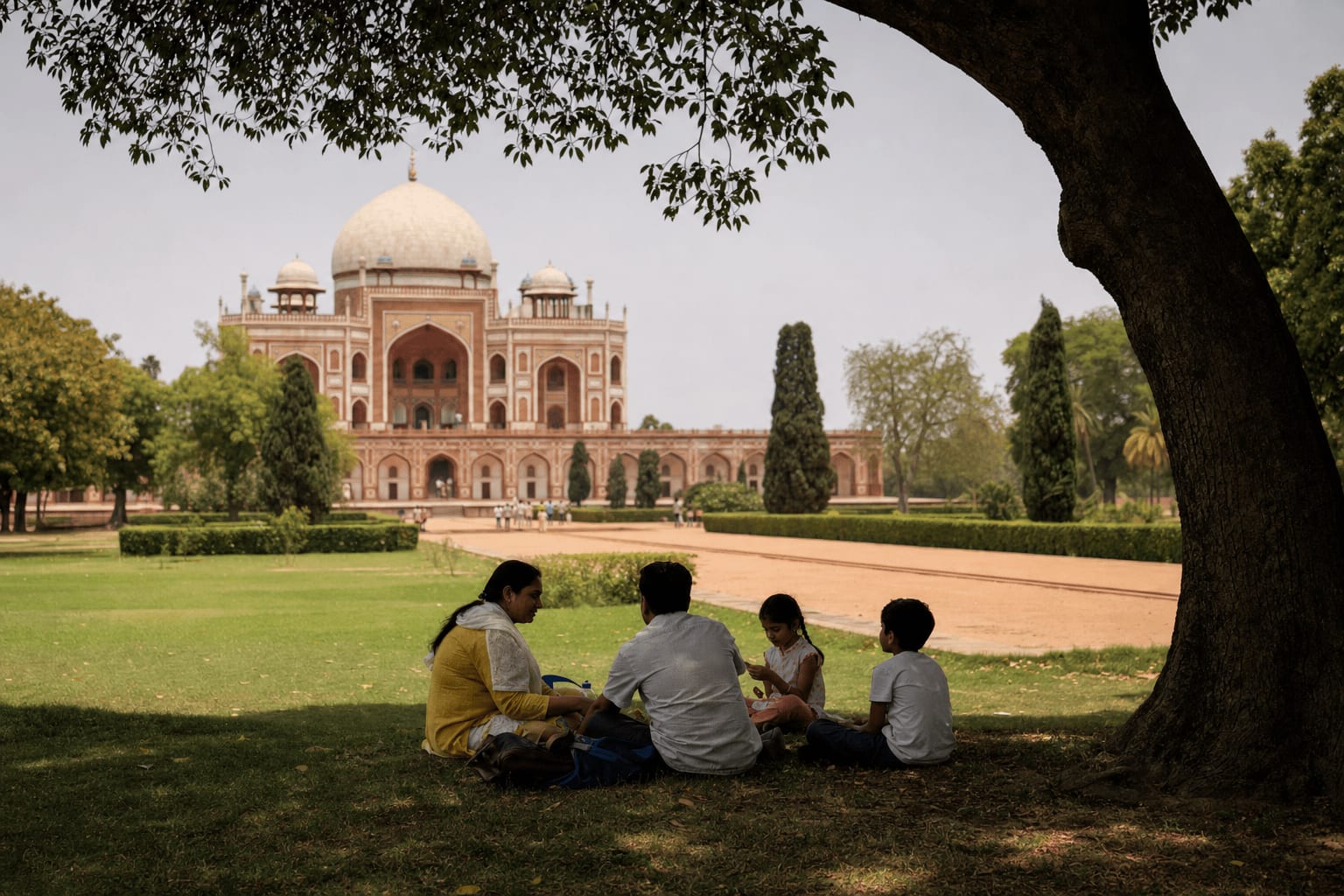
Delhi Tourism calls it the first garden-tomb on the Indian subcontinent, and it says the tomb influenced later buildings, the Taj Mahal among them. The tomb's own page says Bega Begam, Humayun's senior widow, commissioned it, and that it is open daily from sunrise to sunset.
We have left out the year it was built. Delhi Tourism gives two different years on two different pages, and we would rather give you none than the wrong one. Choose this stop if you like a place that rewards slow walking. It is a garden first and a monument second, and a group of any age can sit down in it. That makes it a good stop for the middle of a long day.
Qutub Minar
The Qutub Minar was begun by Qutb-ud-Din Aibak in 1199, and Iltutmish added three more storeys, according to Delhi Tourism. The heritage page gives its height as 72.5 metres and mentions the Alai-Darwaza gate of 1311 among the buildings around it.
The Iron Pillar in the courtyard is the part visitors skip and shouldn't. The page says it bears an inscription in Sanskrit in Brahmi script of the fourth century AD. Children up to 15 are free, and the hours are sunrise to 08:00pm. Many families go to the minar for the photograph and leave. Stay long enough to walk the courtyard.

Lotus Temple
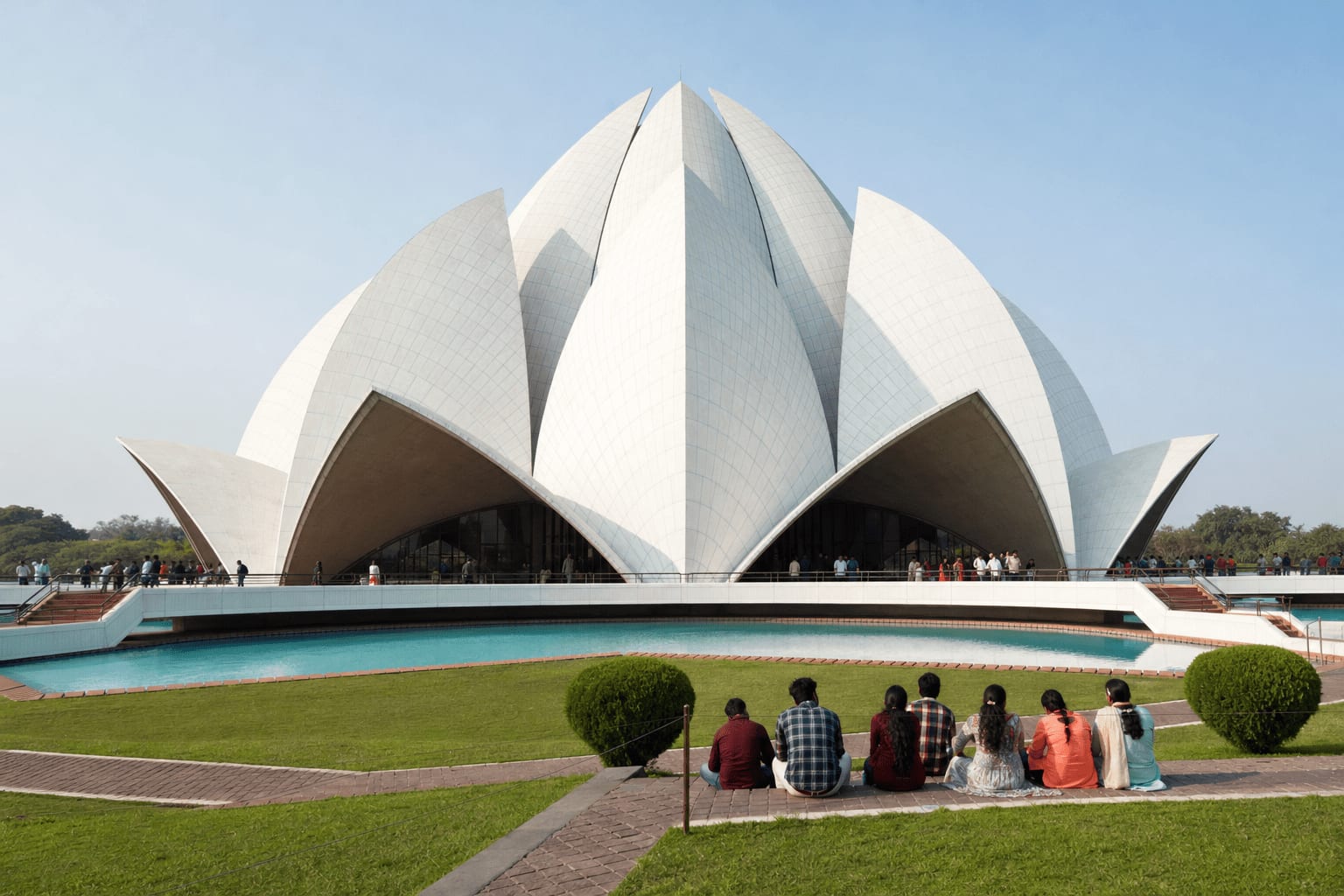
The Lotus Temple is open Tuesday to Sunday, from 9am to 5:30pm, and entry is free. A group of 20 arriving at once is a lot of people at one door. Split the group, or arrive in the first hour of opening so that nobody waits in a line.
Free entry makes it an easy add-on to a day of ticketed places. Leave time at the end for nothing at all. Sit down.
Akshardham
Akshardham is the one place on this list where the rules are strict enough to change your plan. Its visitor page lists luggage, mobile phones, cameras, electronic items and food and drink as not allowed. A free cloakroom is offered before the security queue. First entry is at 10:00 am and last entry at 6:30 pm, and it is closed every Monday.
Think about what that means for a group. If you travel with bags, someone has to leave them with the cloakroom, and you need the time to do that for twelve people. Don't leave valuables there: the page says no money or valuables may be deposited. The simplest answer is to leave bags in the vehicle with the driver and carry only what you need. That is one of the few places where a driver who stays with the vehicle does something no one else can do for you.
Akshardham is in the east of the city, away from the rest of the list, so give it a half day of its own instead of squeezing it between two others. It is also the stop that sets the date: if Monday is your only free day, you will not get in.
Other places the ranking pages list
If you have the days, the pages that rank for this search also list Lodhi Garden, Connaught Place, Hauz Khas, Majnu Ka Tilla, Raj Ghat, the ISKCON Temple, Coronation Park and the Kiran Nadar Museum of Art. We have not read official pages for these, so we are not describing them. Look each one up before you go, and check its days and hours as you would for the others.
A word on how to use that list. These are the places to add when the core is done and you have a day with nothing in it. They are not a reason to cut Humayun's Tomb or the Red Fort. A first visit to Delhi that skips the core to see five smaller places has missed what most people came for.
Putting it into days
Here is the part the lists leave out. Same places, three lengths of trip. These are suggestions, not a schedule, and we have grouped by the area each place sits in. Ask your driver to confirm the order on the day, because he knows which roads are slow.
Three ways to spend one, two or three days in Delhi
| Length | Day 1 | Day 2 | Day 3 |
|---|---|---|---|
| One day | Red Fort, Jama Masjid, then India Gate at the end | ||
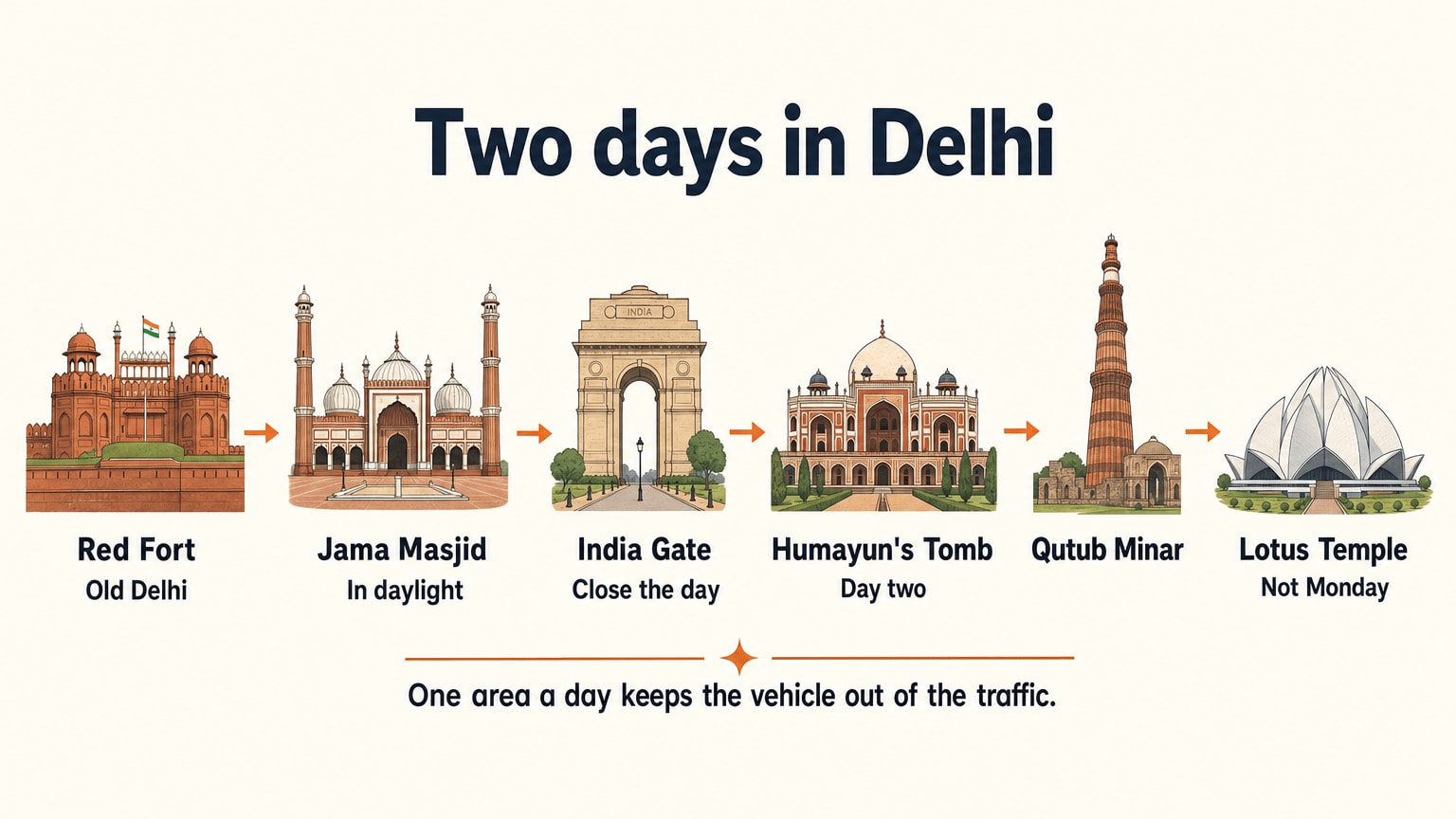
| Two days | Old Delhi, then India Gate | Humayun's Tomb, Qutub Minar, Lotus Temple | |
| Three days | Old Delhi, then India Gate | Humayun's Tomb, Qutub Minar, Lotus Temple | Akshardham, then Chandni Chowk or anything from the other list |
None of these puts Akshardham or the Lotus Temple on a Monday. If your trip falls on a Monday, swap the days around so those two land on any other day, and put the Red Fort in the Monday slot, since the fort is now open.
If you have one day
Be honest about what one day can do. It can do Old Delhi properly, plus India Gate at the end. It can't do the south as well. Trying to is the mistake that wastes the day, because the distance between the two parts of the city eats the hours you thought you had.
Pick the one you care about. If you want the Mughal city and the markets, take Old Delhi. If you want gardens, a tomb and a tower, take the south, and drop the Red Fort for another visit.
If you have two days
This is the best fit for most families. One day for the old city, one for the south. Both days have a natural end: India Gate on the first, the Lotus Temple's calm on the second, and each day is short enough that older relatives and children are not finished by lunch.
If you have three days
Give Akshardham its own day, because of the rules and the distance. With the rest of the day free, add Chandni Chowk for food, or one of the places from the other list. You can take it slowly. That is the point of a third day.
When to go
Delhi Tourism says the best time to visit Delhi is from October to March, when the weather is at its best. That is the official answer, and it matches what most guides say.
We haven't read a weather source for the other months, so we won't describe them in numbers. A sensible rule for any month is the one every driver already knows: do the outdoor sights early. A plan with the Red Fort at the start of the morning and a shaded garden in the middle of the day suits any season. Carry water. Wear shoes you can walk in.
Because October to March is the time most people choose, expect the popular places to be busier then. We don't have a visitor count to give you, so take that as a general sense and not a measured fact.
Getting around Delhi as a group
A group of two or three people can get around with whatever vehicle is available. A group of 12 or 20 needs to plan, because the places on this list have parking and entry arrangements built for ordinary traffic, not for a party that arrives all at once.
Choose the vehicle by the number of travellers, then by luggage. Here are the vehicles we run, by group size.
Vehicle by group size, from our home page
| Travellers | Vehicle | Seats |
|---|---|---|
| 1 to 6 | Innova Crysta or Hycross | Car |
| 7 to 12 | Tempo Traveller | 12 |
| 13 to 16 | Force Urbania | 16 |
| 17 to 20 | Tempo Traveller | 20 |
| 21 to 27 | Mini bus | 27 |
| 28 to 41 | Luxury coach | 41 |
A day of sightseeing is a day of getting in and out of the vehicle. If your group is exactly 12, a 12 seater is full, and a day with bags and water bottles will feel it. Ask about the next size up. We'd rather you ask than find out when the door is open.
Our price is one figure that includes tolls, state tax, parking and driver allowance, so you don't pay the driver anything on the road. For a day that stops at six places, the parking line matters. Our guide to car rental in Delhi explains what an all-in price should cover, and what to ask any operator before you pay.
A note on what we do and don't do. Our routes run out of Delhi, and the destinations on our site are Agra, Jaipur, Rishikesh and Haridwar, Manali, and Kedarnath and the Char Dham. We add a guide separately if you want one, and we help with tickets. The driver is a driver, not a licensed tour guide. If you want sightseeing in the city as well as a trip out, ask the trip manager what can be arranged. We would rather answer that in a message than promise it here.
If you are visiting from abroad
A first visit to Delhi is a lot to take in, and a day with a stranger at the wheel is one more thing to wonder about. So here is what we would want to know in your place.
Our drivers speak English, so guests from abroad feel at ease, and they are KYC-checked. You get the driver's name, phone number and vehicle number 24 hours before pickup, which means you can check who is coming before the day starts. A guide can be added separately, and we can help with tickets. The driver is a driver. He knows the roads, and he does not replace a licensed guide at the Red Fort or the Qutub Minar. If the history matters to you, ask for a guide when you send your message.
Sightseeing in Delhi with a guide and a driver is two separate jobs, and it is better to keep them apart in your head. The driver gets you from the Red Fort to Humayun's Tomb. The guide tells you what you are looking at when you get there.
Questions to ask before a Delhi day with a driver
The same short list we gave in our guide to car rental in Delhi works for a day of sightseeing, with a few additions for the places above.
Is the vehicle your own, and is it the one in the photograph? Does the price include tolls, state tax, parking and driver allowance? Do I pay the driver anything on the road? What does the quote assume for the length of the day, and what happens if we run long? Will the driver wait at each stop, and where will he be when we come out? Can he drop us at one gate and meet us at another?
That last pair matters more than it sounds. A big site can have more than one gate, and a group that walks out of the wrong one has a long walk back to the vehicle at the end of a long day. Settle the meeting place before anyone gets out.
Ask for the answers in a message, not only on a call. Then you have the words in writing. Read them the evening before you go, with the opening days beside them.
Habits that save the day
Start early, so a late start doesn't push the last stop past its closing time. Check the day the evening before, because one rule here changed in February 2026 and another will. Agree a meeting place and a time at every stop. And don't plan six stops. Plan three, and let the fourth be a gift.
Delhi suits slow days, and the best of them have two or three places in them, not eight. Choose by area, check Monday, and leave India Gate for the end.
If you're planning a trip out of Delhi as well, the home page lists which vehicle fits each group size, from 1 to 41 people, and more guides will follow on the blog.
Frequently asked questions
What are the best places to visit in Delhi for a first visit?
The Red Fort, Jama Masjid, India Gate, Humayun's Tomb, Qutub Minar, the Lotus Temple and Akshardham. They appear on almost every ranking page for this search. Group them by area and check Monday, when the Lotus Temple and Akshardham are closed.
Is the Red Fort closed on Monday?
Not any more. The Archaeological Survey of India ordered, in an order dated 13 February 2026, that it stays open on all days of the week, including Mondays. Many websites still say it is closed, so confirm before you go.
Which places in Delhi are free?
Delhi Tourism lists entry to the Lotus Temple and India Gate as free. The Qutub Minar page says children up to 15 are free. We haven't listed ticket prices for other places, because they change. Check each one before you go.
How many days do you need in Delhi?
One day covers Old Delhi and India Gate. Two days adds the south: Humayun's Tomb, Qutub Minar and the Lotus Temple. Three days gives Akshardham a day of its own and leaves room for Chandni Chowk.
What is the best time of year to visit Delhi?
Delhi Tourism says October to March, when the weather is at its best. Whatever the month, do the outdoor sights in the morning.
Can I take a phone or camera into Akshardham?
No. Akshardham's visitor page lists mobile phones, cameras, luggage, electronic items and food and drink as not allowed, and offers a free cloakroom before the security queue. It says no money or valuables may be left there.
Can you add a guide to a Delhi day?
Yes, a guide can be added separately, and we help with tickets. The driver is not a licensed tour guide. Ask the trip manager about a Delhi day when you send your message.